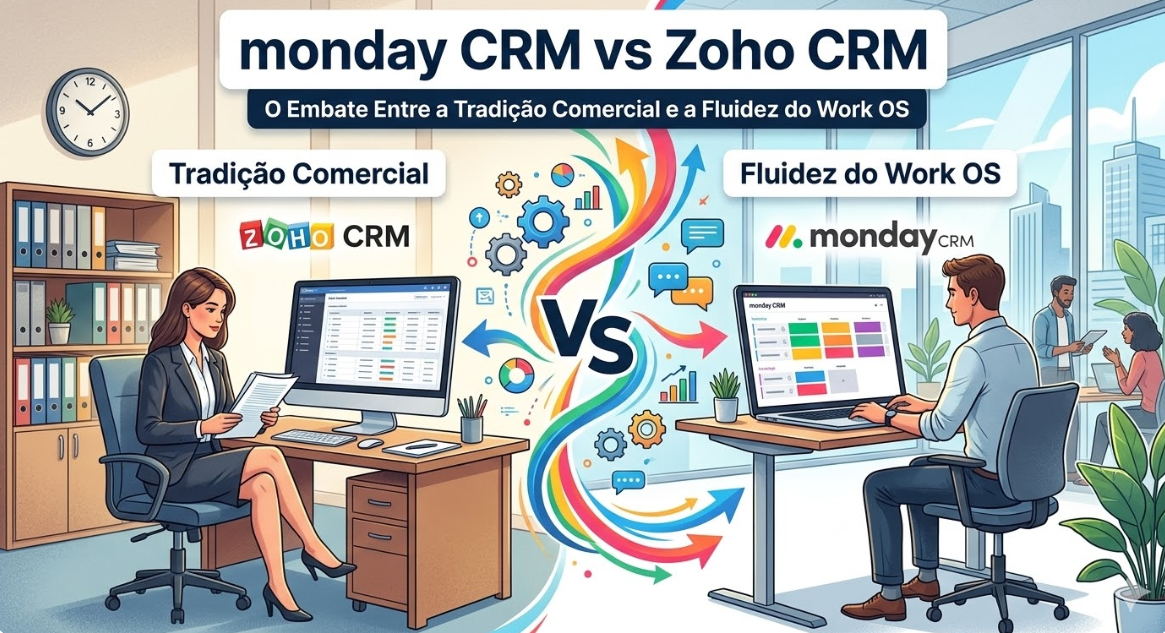
In the evolution of any B2B company, the commercial department is frequently the first to demand specialized technology. However, as operations scale, leaders face a structural challenge: closing the sale is just the beginning of the customer relationship. The way that information transitions from commercial to delivery defines business profitability. It is in this scenario of efficiency seeking that sales directors and operations leaders face one of the most complex debates in the SaaS market: monday CRM vs Zoho CRM.\r\n\r\nOn one hand, Zoho CRM is an industry titan. A historically established platform, deeply specialized in managing complex funnels and built under the traditional lens of customer relationship. On the other hand, monday CRM represents the new generation of enterprise platforms: built on a Work Operating System (Work OS), it proposes breaking the commercial department’s isolation, integrating pre-sales, sales, customer success, and operations in a single unified view.\r\n\r\nAt Audatia, we’ve guided dozens of organizations through this decision. What we’ve learned is illuminating: the “best” CRM is not necessarily the most feature-rich, but the one that best aligns with your organization’s maturity model and operational trajectory.\r\n\r\n \r\n\r\n \r\n
Zoho CRM: The Fortress of Commercial Specialization
\r\n
Philosophy and DNA
\r\nZoho CRM was built with a singular obsession: master the complexities of commercial relationships. Every feature, every customization option, and every workflow is designed with the assumption that managing client relationships is the primary business function. It is, without question, one of the most powerful CRM platforms on the market for pure commercial management.\r\n
Strengths
\r\n- Advanced deal management: Zoho’s tools for managing complex, multi-stakeholder sales are exceptionally powerful.\r\n- Customization depth: Zoho allows almost unlimited customization of fields, workflows, and interfaces.\r\n- Predictive analytics: Zoho’s AI capabilities for sales forecasting are among the best in the industry.\r\n- Integration with Zoho ecosystem: If you use other Zoho products (Projects, Books, People), integration is seamless.\r\n- Affordable at scale: For large sales teams, Zoho’s pricing becomes attractive.\r\n- Extensive automation: Workflow automation is powerful and well-designed.\r\n
Limitations
\r\n- Data isolation: Despite being a powerful CRM, integrating Zoho CRM with non-Zoho systems requires significant work.\r\n- Interface complexity: The sheer power of Zoho CRM creates a steep learning curve.\r\n- Implementation challenges: Deploying Zoho CRM typically requires professional services.\r\n- Post-sale integration: Moving customer data from CRM to operations is not native; it requires middleware.\r\n- Reporting silos: Sales metrics don’t naturally connect to operational outcomes.\r\n
monday CRM: The Integration Layer of a Larger System
\r\n
Philosophy and DNA
\r\nmonday CRM doesn’t claim to be the most powerful CRM tool. Instead, it is designed as the commercial component of a comprehensive Work Operating System. The philosophical premise is that in modern organizations, CRM doesn’t exist in isolation. Sales data must flow to operations, success metrics must align with delivery, and the customer perspective must be shared across all departments.\r\n
Strengths
\r\n- Native integration with operations: When a deal closes, the system automatically creates projects for delivery, notifies success teams, and aligns finance.\r\n- Visual collaboration: Sales, operations, and success teams see the customer journey visually, reducing misalignment.\r\n- Flexible customization: Unlike point solutions, monday CRM allows you to structure deal stages to match your specific process.\r\n- Unified reporting: All metrics—sales, delivery, success—are visible in a single dashboard.\r\n- Scalable automation: Automation rules can orchestrate complex processes across departments.\r\n- Built for team coordination: The visual interface and collaborative features mean departments naturally align.\r\n
Limitations
\r\n- CRM-specific features are less advanced: For pure sales power, Zoho CRM has more sophisticated tools.\r\n- Learning curve: Teams accustomed to traditional CRMs find the general Work OS interface less immediately intuitive.\r\n- Requires process maturity: You can’t just “turn it on.” You need to design how sales connects to other operations.\r\n- Higher per-user cost: monday.com’s per-user pricing is higher, but you’re replacing multiple tools.\r\n
The Critical Divergence: What Happens When Sales Meets Reality
\r\n
In a Zoho CRM Organization
\r\nA sales team closes a complex, multi-year deal. The deal terms are recorded in Zoho CRM. However:\r\n1. The customer success team uses a separate system to track onboarding.\r\n2. The delivery team uses yet another tool to manage project execution.\r\n3. Finance uses accounting software to manage invoicing.\r\n4. When delivery discovers the deal structure is different than what sales recorded, misalignment occurs.\r\n5. The customer success team doesn’t see the commercial terms and may make commitments outside the scope.\r\n\r\nThe problem: data in silos creates operational friction.\r\n
In a monday CRM Organization
\r\nThe same sales team closes the same deal. The difference:\r\n1. Deal terms are recorded in monday CRM.\r\n2. Automation immediately creates a delivery project with the contract terms visible.\r\n3. Finance receives deal information automatically and can set up billing.\r\n4. Customer success team is automatically notified and sees the service level commitments.\r\n5. All teams access the same customer record, all see the commercial terms, all understand the obligations.\r\n\r\nThe advantage: data flows create operational alignment.\r\n
Customization Philosophy: The Fundamental Difference
\r\n
Zoho’s Approach
\r\nZoho customization is deep but narrow. You customize the CRM to your sales process. This creates specialization but also brittleness. When your sales process evolves (which it will), you need to reconfigure the CRM.\r\n
monday.com’s Approach
\r\nmonday.com customization is broad. You design your customer journey once, and it automatically coordinates across sales, delivery, finance, and support. When your process evolves, you change how teams interact with one system, not multiple systems.\r\n
Pricing and Total Cost of Ownership
\r\n
Zoho CRM Pricing Structure
\r\n- CRM alone: $18-80 per user per month\r\n- For customer success: Need separate tool (~$50-200 per month per user)\r\n- For project delivery: Need separate tool (~$50-150 per month per user)\r\n- Total for 30-person sales team: ~$20,000/year for Zoho CRM alone, plus other tools\r\n
monday CRM Pricing Structure
\r\n- monday.com (all features): $40-100 per user per month\r\n- Includes CRM, project management, success management, automation\r\n- Total for 30-person organization: ~$20,000/year replaces CRM + Projects + Success\r\n
Implementation Path
\r\n
Zoho CRM Implementation
\r\n- Duration: 6-12 weeks for enterprise implementation\r\n- Complexity: High (requires deep configuration and often professional services)\r\n- Training: Focus on CRM methodology and features\r\n- Typical challenge: Managing customization complexity\r\n
monday CRM Implementation
\r\n- Duration: 4-8 weeks for integrated approach\r\n- Complexity: Medium (requires process design but less technical configuration)\r\n- Training: Focus on how sales connects to operations\r\n- Typical challenge: Designing cross-departmental workflows\r\n
Who Should Choose Each Solution?
\r\n
Choose Zoho CRM If:
\r\n- You want the most powerful pure CRM tool available.\r\n- Your sales process is highly complex and specialized.\r\n- You’re using other Zoho products (Projects, Books, People) for other departments.\r\n- Your organization has mature IT resources for implementation and customization.\r\n- You want to maintain sales tools separate from operational tools.\r\n
Choose monday CRM If:
\r\n- You want sales, operations, and success in one integrated platform.\r\n- Your customer journey is complex and requires coordination across departments.\r\n- You’re prioritizing operational efficiency and cross-department alignment.\r\n- You want easier implementation and faster time to value.\r\n- You plan to implement AI agents and advanced automation across your operation.\r\n
Final Verdict: Specialization Versus Integration
\r\nZoho CRM is the answer to the question: “How do we create the most powerful sales environment possible?”\r\nmonday CRM is the answer to the question: “How do we create the most efficient customer journey from prospect to success?”\r\n\r\nFor organizations where commercial success depends entirely on sales sophistication (like traditional B2B sales-driven companies), Zoho CRM is an exceptional choice.\r\n\r\nFor organizations where customer success depends on coordinating sales with delivery and support (which describes most modern companies), monday CRM represents a fundamentally superior choice.\r\n\r\nAt Audatia, we recommend Zoho CRM for companies with highly specialized sales operations and where commercial and operations are strictly separated. We recommend monday CRM for companies where operational maturity and cross-functional alignment are strategic priorities.\r\n\r\nThe choice is about your organization’s architecture. Choose wisely—this decision will shape how your teams collaborate for years to come.