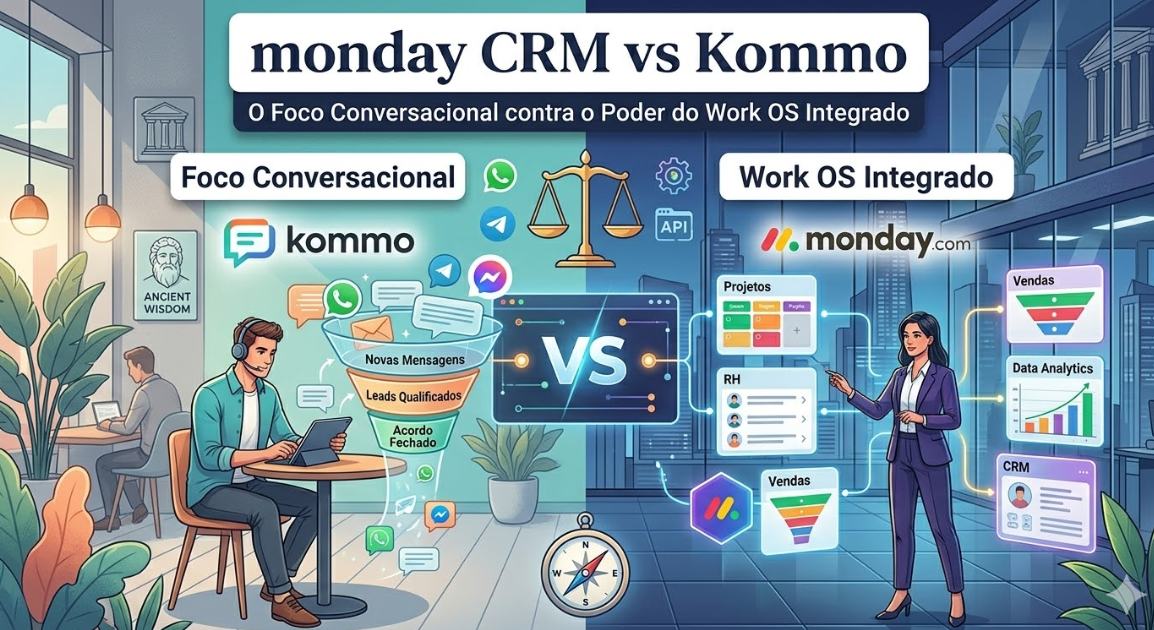
In the era of instantaneous communication, the way companies interact with their customers has undergone profound transformation. Especially in Brazil, the use of WhatsApp and social networks to close deals has become the norm in many B2B and B2C operations. It is before this reality of high message volume that commercial leaders and operations directors face a critical technological dilemma: monday CRM vs Kommo.\r\n\r\nOn one hand, Kommo (formerly known as amoCRM) positions itself as the pioneer of “Conversational CRM.” A tool built thinking about messengers, with strong WhatsApp integration, focused on capturing and converting leads through quick chats. On the other hand, monday CRM (anchored in the architecture of monday.com) represents evolution toward the Work Operating System (Work OS): a platform designed to consolidate the entire customer journey, connecting commercial negotiation to technical delivery, billing, and support.\r\n\r\nAt Audatia, we’ve observed a fascinating trend: Kommo is exceptional at lead capture and rapid conversion, but monday CRM’s architectural maturity makes it superior for organizations that need to coordinate beyond the sales conversation.\r\n\r\n \r\n\r\n \r\n
Kommo: The Conversational CRM for Instant Sales
\r\n
Philosophy and DNA
\r\nKommo was born from a clear observation: sales conversations increasingly happen in messaging apps, not email. WhatsApp, Telegram, Facebook Messenger—these are where your customers are. Kommo’s philosophy is to bring CRM management directly into the conversation stream. Forget switching between apps; manage your entire customer relationship within the messages.\r\n
Kommo’s Strengths
\r\n- Native WhatsApp integration: This is Kommo’s killer feature. Chat with customers in WhatsApp, and it’s automatically logged in your CRM. Seamless experience.\r\n- Conversation-centric workflow: The entire interface is built around conversations, not abstract deal stages.\r\n- Rapid adoption: Sales teams love Kommo because it doesn’t add a new tool—it enhances the tool they’re already using (WhatsApp).\r\n- Quick lead capture: Leads are automatically created from conversations. Minimal data entry required.\r\n- Affordable: Kommo is reasonably priced, especially for sales teams focused on conversational sales.\r\n- Automation within conversations: Automated responses, follow-up sequences, all within the messaging interface.\r\n- Global platform: Kommo supports multiple messengers globally.\r\n
Kommo’s Limitations
\r\n- Limited post-conversation management: Once a deal is closed, Kommo doesn’t help manage delivery.\r\n- No operational integration: Finance, delivery, and success teams don’t see customer data unless manually communicated.\r\n- Conversation history is primary: Structured data is secondary. This creates challenges for reporting and analysis.\r\n- Limited automation across departments: Automation is conversation-focused, not process-focused.\r\n- Scaling challenges: As teams grow and deals become complex, the conversational paradigm creates bottlenecks.\r\n
monday CRM: The Unified Customer Journey Platform
\r\n
Philosophy and DNA
\r\nmonday CRM doesn’t try to compete on conversational experience. Instead, it takes a broader view: the customer journey includes sales conversations, but it also includes delivery promises, billing terms, success expectations, and support. Kommo manages the conversation; monday CRM manages the relationship.\r\n
monday CRM’s Strengths
\r\n- Complete customer journey: From first conversation through post-sale success, the entire journey is visible in one place.\r\n- Integration with delivery: When a deal closes in monday CRM, delivery projects are automatically created.\r\n- Visual collaboration: All teams (sales, delivery, finance, success) see the customer journey together.\r\n- Structured data: Unlike purely conversational interfaces, monday CRM emphasizes structured data, enabling powerful reporting.\r\n- Unified reporting: All customer metrics (acquisition cost, deal value, delivery performance, churn risk) are visible in one dashboard.\r\n- Scalable operations: As complexity increases, the platform scales gracefully.\r\n- Flexible integration: Works with Kommo or other messaging tools through integrations. You’re not locked into a specific messenger.\r\n
monday CRM’s Limitations
\r\n- Not optimized for messaging: The interface isn’t designed specifically for the conversation stream.\r\n- Requires data discipline: Unlike Kommo’s automatic capture, monday CRM requires more intentional data entry.\r\n- Learning curve: Teams accustomed to Kommo’s conversational interface find monday.com’s structured interface less intuitive.\r\n- Higher per-user cost: More expensive than Kommo per user.\r\n
The Operational Maturity Question
\r\n
What Kommo Solves
\r\nKommo solves the problem of lead capture and rapid conversion in a messaging-first world. If your sales process is brief (quick quote, immediate closing), Kommo is exceptional.\r\n
What monday CRM Solves
\r\nmonday CRM solves the problem of coordinating post-sale delivery. If your customer success depends on multiple teams (delivery, finance, support) coordinating what was sold, monday CRM is superior.\r\n
Practical Scenario: Two Sales Models
\r\n
Model 1: Rapid Transactional Sales (E-commerce, Digital Services)
\r\nA digital marketing agency uses WhatsApp to sell services. Quick consultations, quick quotes, quick closures. Many deals daily.\r\n\r\nKommo is ideal here. Sales conversations capture leads, close deals, and there’s minimal post-sale coordination needed (services are standardized).\r\n
Model 2: Complex B2B Sales (Professional Services)
\r\nA consulting firm uses WhatsApp to initiate conversations, but deals are complex. Multiple modules, custom pricing, complex delivery.\r\n\r\nmonday CRM is ideal here. WhatsApp initiates the conversation, but deal management, delivery coordination, and success tracking require structured integration.\r\n
Hybrid Approach: Kommo + monday.com
\r\nThe best approach for complex sales is often: – Use Kommo for initial customer conversations and lead capture (leverage WhatsApp’s ubiquity).\r\n- Integrate Kommo with monday CRM for deal management and delivery coordination.\r\n- Sales team chats with customers in Kommo. Deal terms are logged in monday CRM. Delivery team sees the exact commitment in their project.\r\n\r\nThis combination gives you the best of both worlds: conversational efficiency + operational coordination.\r\n
Pricing Comparison
\r\n
Kommo Pricing
\r\n- Starts at ~$20-80 per user per month\r\n- Very affordable, especially for conversational sales\r\n- Pure CRM; doesn’t include project management or operations\r\n
monday CRM Pricing
\r\n- Starts at ~$40-100 per user per month\r\n- More expensive per user but includes CRM, projects, and operations\r\n
Implementation Path
\r\n
Kommo Implementation
\r\n- Duration: 2-4 weeks\r\n- Complexity: Low (straightforward integration with WhatsApp)\r\n- Training focus: Conversational CRM usage\r\n- Time to productivity: 1-2 weeks\r\n
monday CRM Implementation
\r\n- Duration: 4-8 weeks\r\n- Complexity: Medium (requires integration with Kommo or other messaging tools)\r\n- Training focus: How sales conversations translate to delivery execution\r\n- Time to productivity: 3-4 weeks\r\n
Who Should Choose Each Platform?
\r\n
Choose Kommo If:
\r\n- Your sales process is conversation-driven and rapid.\r\n- You rely heavily on WhatsApp for customer communication.\r\n- Your deals are relatively simple and quick to close.\r\n- You want minimal learning curve and maximum adoption.\r\n- Budget is a primary constraint.\r\n- Post-sale coordination is minimal (standardized services).\r\n
Choose monday CRM If:
\r\n- Your customer journey includes complex post-sale coordination.\r\n- You need multiple teams (sales, delivery, finance, success) seeing the same information.\r\n- Deal complexity requires structured data and reporting.\r\n- You’re planning significant growth and need scalable processes.\r\n- You want operational transparency and unified metrics.\r\n
Final Verdict: Conversational Efficiency vs Operational Coordination
\r\nKommo is exceptional at what it does: turning WhatsApp conversations into sales. If your business model is rapid conversion through messaging, Kommo is optimal.\r\n\r\nmonday CRM is exceptional at coordinating complex customer journeys. If your business model requires delivering on complex promises, monday CRM is optimal.\r\n\r\nAt Audatia, we recommend this approach: – For simple, transactional B2C sales: use Kommo.\r\n- For complex B2B sales: use Kommo for conversation + monday CRM for coordination.\r\n- For large organizations with mixed sales models: use both platforms integrated.\r\n\r\nThe future of sales is conversational, but the future of business is coordinated. The companies that master both—capturing leads through conversations and coordinating delivery through integrated platforms—will win.\r\n\r\nChoose based on your sales model. Then integrate to solve the inevitable problem: what happens after the conversation ends?