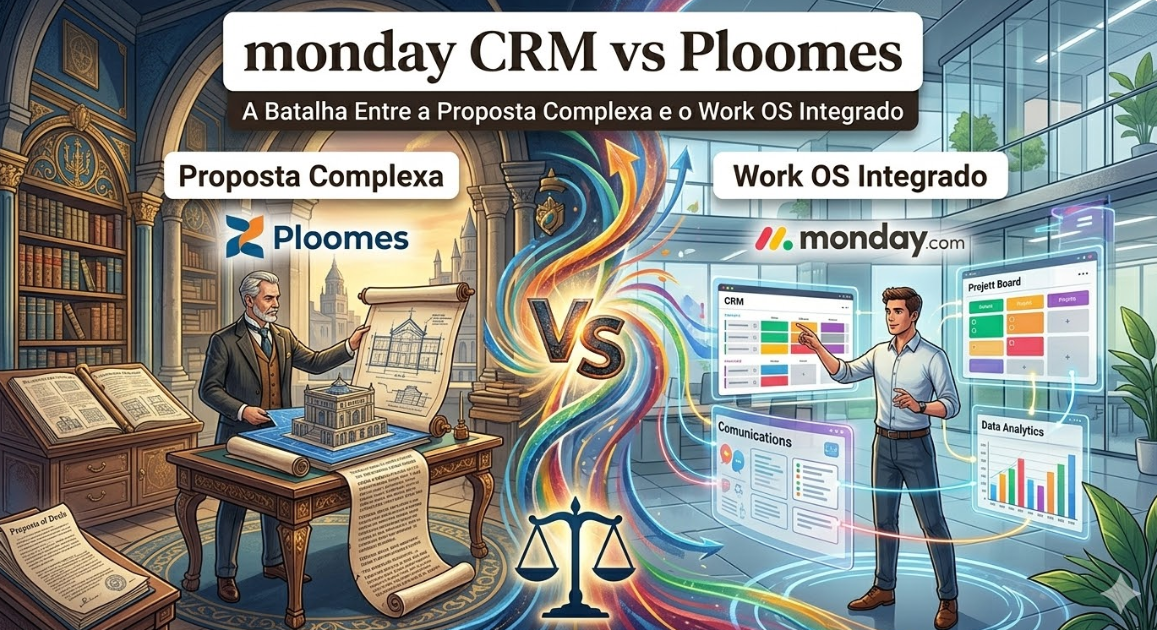
In the journey of structuring a high-performance B2B commercial operation, there comes a moment when managing just client contact is insufficient. Sales become consultative, proposals involve rigorous calculations, and service delivery requires orchestration across multiple teams. It is in this scenario of operational complexity that commercial directors and operations leaders face one of the most technical debates in the software market: monday CRM vs Ploomes.\r\n\r\nOn one hand, Ploomes is one of the most robust Brazilian tools on the market, designed with relentless focus on complex B2B sales, standing out for its CPQ engine (Configure, Price, Quote) for generating proposals and sales orders. On the other hand, monday CRM represents the global vanguard of Work Operating Systems (Work OS): a highly visual, modular, and collaborative platform, conceived to break silos between sales, planning, and project execution.\r\n\r\nAt Audatia, we’ve implemented both solutions in complex B2B environments. What we’ve learned is critical: Ploomes is exceptional at proposal management, but monday CRM’s architectural integration is superior for end-to-end operational coordination.\r\n\r\n \r\n\r\n \r\n
Ploomes: The CPQ Specialist for Complex B2B Sales
\r\n
Philosophy and DNA
\r\nPloomes was built for a specific challenge: managing complex, multi-product, multi-stakeholder B2B sales. The company understood that Brazilian companies needed more than a simple CRM—they needed tools to configure complex proposals, calculate pricing accurately, and generate professional sales orders. This is Ploomes’ core obsession.\r\n
Ploomes’ Strengths
\r\n- Exceptional CPQ engine: Ploomes’ Configure, Price, Quote functionality is best-in-class. Complex product combinations, volume discounts, recurring pricing—all handled natively.\r\n- Proposal generation: Professional, customizable proposal generation. Your sales team looks professional to customers.\r\n- Sales order management: Track the full lifecycle from proposal to signed order.\r\n- Complex deal structures: Built for deals with multiple products, custom terms, and complex pricing.\r\n- Proven in Brazil: Well-established Brazilian tool with deep understanding of local business practices.\r\n- Strong reporting: Detailed sales analytics focused on deal composition and pricing.\r\n
Ploomes’ Limitations
\r\n- No execution component: Once a deal is ordered, Ploomes doesn’t help manage delivery.\r\n- Limited post-sales integration: Handoff to delivery teams requires manual coordination.\r\n- Poor operational transparency: Finance and delivery teams don’t see sales terms unless manually communicated.\r\n- Silos between sales and operations: Data doesn’t flow natively to projects or execution tools.\r\n- Growing complexity: As deals close, coordinating delivery across teams becomes increasingly difficult.\r\n
monday CRM: The Integrated Platform for Complex Delivery
\r\n
Philosophy and DNA
\r\nmonday CRM doesn’t claim to have the best CPQ engine (it doesn’t). Instead, it’s designed as the commercial component of a comprehensive Work Operating System. The philosophy is that complex sales require equally complex coordination during delivery. The platform’s strength is not in proposal generation—it’s in connecting that proposal to execution.\r\n
monday CRM’s Strengths
\r\n- Native integration with delivery: When a deal closes, projects are automatically created with all commercial terms visible.\r\n- Visual collaboration: Sales teams and delivery teams see the customer journey together, reducing misalignment.\r\n- Flexible deal structures: Design custom deal stages and fields to match your exact sales process.\r\n- Powerful automation: When a deal closes, finance is notified, delivery projects are created, and success teams are alerted—all automatically.\r\n- Unified reporting: Sales metrics automatically connect to delivery performance and customer profitability.\r\n- Scalable operations: As complexity increases, the platform scales gracefully because it was designed for coordination.\r\n- Team communication: Built-in collaboration means sales and delivery teams communicate within the platform, not via email.\r\n
monday CRM’s Limitations
\r\n- Limited CPQ functionality: No built-in proposal generation or complex pricing configuration.\r\n- Not specialized for proposal management: You need separate tools (like Proposify or Basecamp) for complex proposal generation.\r\n- Learning curve for sales teams: Teams accustomed to specialized CRMs find the general Work OS interface less intuitive.\r\n- Higher per-user cost: More expensive per user, but you’re replacing multiple tools.\r\n
The Critical Architectural Question
\r\n
Ploomes’ Strength: Proposal Excellence
\r\nPloomes excels at closing deals. Complex proposals, professional presentation, accurate pricing. Sales teams love it because it makes them look professional and handles complexity.\r\n
monday.com’s Strength: Execution Excellence
\r\nmonday.com excels at delivering on the deal. Complex delivery projects, multiple teams, transparent costs. Delivery teams love it because it shows them exactly what was promised.\r\n\r\nThe question is: which is your constraint?\r\n
Practical Scenario: The Complex Deal Journey
\r\n
In a Ploomes-Centric Organization
\r\n1. Sales team builds a complex proposal (multiple products, custom pricing, recurring revenue component).\r\n2. Proposal is beautifully presented in Ploomes.\r\n3. Customer signs. Deal closes in Ploomes.\r\n4. Sales team manually notifies delivery team (often via email).\r\n5. Delivery team reviews email and tries to understand what was promised.\r\n6. Finance team manually extracts deal terms from Ploomes and creates invoice.\r\n7. Problems emerge: Delivery team thought the project was six months. Sales promised three. Customer expectations misaligned.\r\n8. Scope creep and margin erosion result.\r\n
In a monday CRM-Centric Organization
\r\n1. Sales team builds a complex deal structure in monday CRM (or uses integration with proposal tools like Proposify).\r\n2. Proposal is generated and presented.\r\n3. Customer signs. Deal closes in monday CRM.\r\n4. Automation immediately creates a delivery project with all commercial terms visible.\r\n5. Finance receives deal notification and sets up billing.\r\n6. Success team sees the deal and prepares for onboarding.\r\n7. All teams see the same customer record with identical deal terms.\r\n8. Delivery proceeds flawlessly because all teams understand the exact commitment.\r\n
Hybrid Approach: Can They Work Together?
\r\nYes, many organizations use Ploomes for complex proposal generation and pricing, then integrate it with monday.com for execution. However, this requires:- Custom integrations via Zapier or n8n.\r\n- Manual data mapping between systems.\r\n- Additional complexity and potential for data misalignment.\r\n\r\nThe integration works, but it’s not as seamless as native integration.\r\n
Pricing Considerations
\r\n
Ploomes Pricing
\r\n- Starts at ~R$300-600 per month per user\r\n- For a 10-person sales team: ~R$1,500-3,000/month\r\n- Pure CRM + CPQ tool; doesn’t include project management or operations\r\n
monday CRM Pricing
\r\n- Starts at ~$40-100 per user per month\r\n- For a 10-person sales team: ~$400-1,000/month\r\n- Includes CRM, project management, operations, and automation\r\n
Implementation Path
\r\n
Ploomes Implementation
\r\n- Duration: 4-8 weeks\r\n- Complexity: Medium (CPQ configuration can be intricate)\r\n- Training focus: CPQ usage, proposal generation, sales process\r\n- Time to productivity: 3-4 weeks\r\n
monday CRM Implementation
\r\n- Duration: 6-10 weeks (includes integration with proposal tools)\r\n- Complexity: Medium-High (requires cross-departmental process design)\r\n- Training focus: How sales integrates with delivery and operations\r\n- Time to productivity: 4-5 weeks\r\n
Who Should Choose Each Platform?
\r\n
Choose Ploomes If:
\r\n- Your bottleneck is proposal complexity and pricing accuracy.\r\n- Your sales process involves complex product configurations.\r\n- Your delivery is standardized or separate from sales.\r\n- Budget for delivery coordination tools is separate.\r\n- You want specialized CPQ functionality.\r\n- Your team is already familiar with Ploomes (learning curve advantage).\r\n
Choose monday CRM If:
\r\n- Your bottleneck is coordinating complex sales with delivery.\r\n- You need all teams (sales, delivery, finance, success) to see the same customer record.\r\n- Delivery complexity requires tight coordination with sales.\r\n- You’re planning to scale and need efficient operational processes.\r\n- You want a single platform for sales, projects, and operations.\r\n- Margin protection and delivery excellence are strategic priorities.\r\n
Final Verdict: Proposal Specialization vs Operational Integration
\r\nPloomes is the specialist. If your competitive advantage is closing complex deals with professional proposals and accurate pricing, Ploomes is exceptional.\r\n\r\nmonday CRM is the integrator. If your competitive advantage is delivering complex projects efficiently and profitably, monday CRM is superior.\r\n\r\nAt Audatia, we recommend Ploomes for sales-centric organizations where deal complexity is high but delivery is standardized. We recommend monday CRM for organizations where both deal complexity and delivery complexity are high.\r\n\r\nInterestingly, many advanced organizations use both: Ploomes for proposal generation and pricing, monday.com for delivery orchestration. This combination gives you best-of-breed capabilities in both domains. The integration requires attention, but for complex B2B organizations, the investment pays dividends through improved margins and customer success.\r\n\r\nChoose based on your constraint. Solve it systematically.