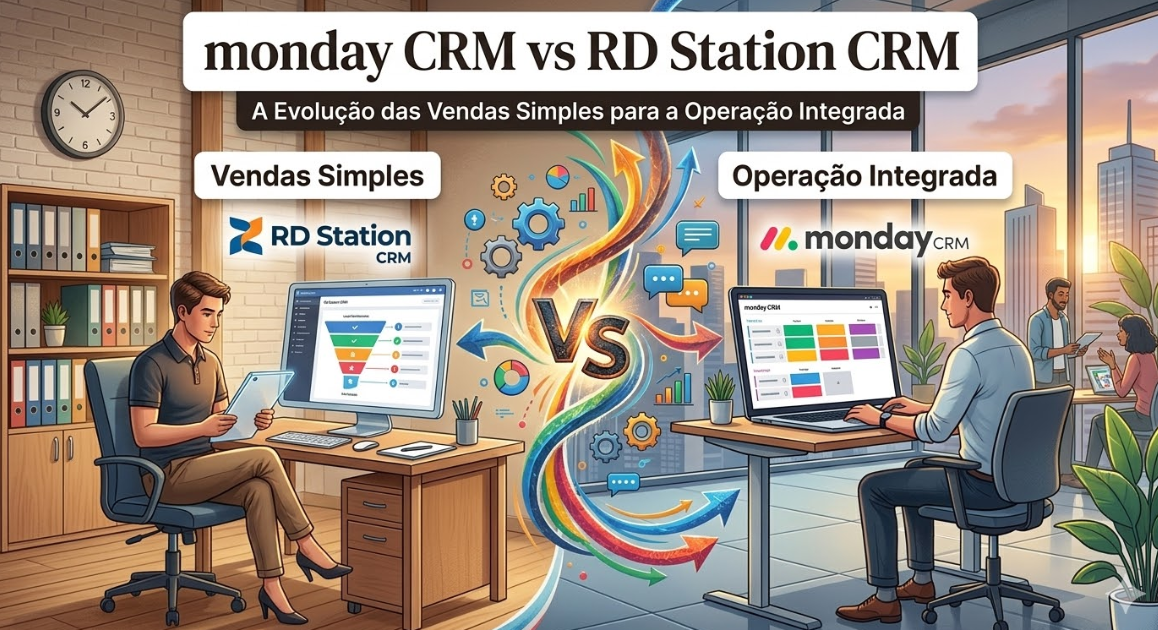
In the Brazilian corporate scenario, structuring a commercial department frequently passes through very well-defined phases. The company abandons spreadsheets, adopts a CRM focused on rapid productivity, and begins scaling sales. However, when operations grow and contracts become more complex, a new bottleneck emerges: the sale is closed, but the delivery and operations team doesn’t know what was promised to the customer. It is at this operational strangulation point that business leaders and IT directors face the debate monday CRM vs RD Station CRM.\r\n\r\nOn one hand, RD Station CRM (formerly Plug CRM) is one of the most popular tools in Brazil, especially for its native integration with RD Station Marketing. It’s a system focused on simplicity, designed so the salesperson records activities and moves opportunities linearly. On the other hand, monday CRM represents technological maturity: built on a Work Operating System (Work OS), it proposes breaking commercial silos and integrating negotiation, execution, and success in a unified platform.\r\n\r\nAt Audatia, we’ve guided dozens of Brazilian companies through this transition. What we’ve learned is illuminating: RD Station CRM is perfect for simple, transaction-based sales. But when complexity emerges, monday CRM’s architectural maturity becomes essential.\r\n\r\n \r\n\r\n \r\n
RD Station CRM: The Tool That Unified Brazilian Sales
\r\n
Philosophy and DNA
\r\nRD Station was born with a clear mission: provide Brazilian companies with a simple, affordable CRM that works seamlessly with RD Station Marketing. The philosophy is accessibility and speed. Your salespeople can quickly register contacts, move them through the funnel, and log activities. No complexity, no jargon—just practical sales management.\r\n
RD Station’s Strengths
\r\n- Perfect integration with RD Station Marketing: If you’re using RD Station’s ecosystem, the integration is native and seamless.\r\n- Simplicity: The interface is clean and straightforward. Your sales team will adopt it quickly.\r\n- Affordable: RD Station CRM is one of the most budget-friendly options for Brazilian companies.\r\n- Activity tracking: Strong emphasis on logging calls, emails, and meetings—creating a sales discipline.\r\n- Mobile accessibility: Good mobile app for sales teams on the move.\r\n- Familiarity: Many Brazilian companies use RD Station, making the tool familiar to potential hires.\r\n
RD Station’s Limitations
\r\n- Limited beyond sales: Once a deal closes, RD Station doesn’t help manage delivery or success.\r\n- Poor integration with non-RD Station tools: If you use ClickUp, monday.com, or other tools, integration requires workarounds.\r\n- Lacks automation across departments: You can’t connect deal closure to project creation or finance processes.\r\n- Limited reporting: Sales-only reports. Difficult to connect sales performance to operational outcomes.\r\n- Growth ceiling: As your organization scales and complexity increases, RD Station’s limitations become apparent.\r\n
monday CRM: The Integrated Operations Hub
\r\n
Philosophy and DNA
\r\nmonday CRM doesn’t claim to be the simplest CRM. Instead, it’s designed as the commercial component of a comprehensive Work Operating System. The philosophy is that in modern organizations, sales doesn’t exist in isolation. Deals that are closed must be delivered, and delivery quality defines customer success and profitability.\r\n
monday CRM’s Strengths
\r\n- Native integration with operations: When a deal closes, execution, finance, and success immediately see the information.\r\n- Unified customer view: All teams (sales, delivery, success, finance) see the same customer information.\r\n- Flexible deal structures: Design stages to match your exact sales process.\r\n- Powerful automation: Connect deal closure to project creation, finance notifications, and success handoff—automatically.\r\n- Visual collaboration: Sales and delivery teams see the customer journey together, reducing misalignment.\r\n- Unified reporting: Sales metrics connect to operational outcomes.\r\n- Scales with complexity: As deals become more complex, monday CRM adapts. As your company grows, the system grows with you.\r\n
monday CRM’s Limitations
\r\n- Requires integration with marketing tools: monday.com has no built-in marketing automation (you’ll use RD Station Marketing, HubSpot, or another tool).\r\n- Higher per-user cost: monday.com is more expensive per user than RD Station CRM, but you’re replacing multiple tools.\r\n- Learning curve: Teams accustomed to RD Station find monday.com’s general interface less immediately intuitive.\r\n- Requires process design: You can’t just “turn it on.” You need to design how sales connects to delivery.\r\n
The Critical Transition Point
\r\nRD Station CRM is designed for companies that look like this:\r\n- Sales is relatively straightforward (transaction-based or lightly consultative)\r\n- Delivery is standardized (minimal variation between customers)\r\n- Small to mid-sized teams (under 50 people)\r\n- Simple contracts (single products, straightforward pricing)\r\n\r\nmonday CRM becomes essential when companies look like this:\r\n- Sales is consultative (different customers, different needs)\r\n- Delivery is complex (project-based, requiring coordination)\r\n- Growing teams (50-500+ people)\r\n- Complex contracts (multiple products, custom terms, professional services)\r\n
Practical Scenario: The Growth Journey
\r\n
Year 1-2: RD Station CRM Era
\r\nA Brazilian SaaS startup uses RD Station CRM to manage its growing sales team. Salespeople log activities, move deals through the funnel, and close contracts. RD Station Marketing nurtures leads. Life is good.\r\n
Year 3: The First Bottleneck
\r\nThe company closes its largest deal ever—a complex, multi-module implementation for a major customer. The sales team records it in RD Station CRM. But:\r\n- The delivery team doesn’t know what was promised.\r\n- Finance doesn’t know the payment terms.\r\n- Customer success doesn’t know the SLA expectations.\r\n\r\nThe customer is unhappy. The deal margin erodes due to scope misalignment.\r\n
The Architectural Moment
\r\nManagement realizes: the bottleneck isn’t sales. It’s the gap between sales and operations. RD Station CRM can’t bridge that gap. They need architectural change.\r\n
Year 4: The monday CRM Transition
\r\nThe company implements monday CRM. Now, when a complex deal closes:\r\n- Automation immediately creates a project in the execution board.\r\n- Delivery sees the exact terms the customer agreed to.\r\n- Finance is automatically notified of payment terms.\r\n- Customer success sees SLA requirements.\r\n\r\nThe team coordinates effectively. Complex deals close without margin erosion.\r\n
Pricing Evolution
\r\n
RD Station CRM Cost Structure
\r\n- Starts at ~$50-200 per month (very affordable)\r\n- For 20-person sales team: ~$300-500/month\r\n- Minimal cost for project management or operations\r\n
monday CRM Cost Structure
\r\n- Starts at ~$40-100 per user/month\r\n- For 20-person sales team: ~$800-2,000/month\r\n- But includes project management, delivery tools, and success tracking\r\n- Often replaces 2-3 other tools, making total cost comparable\r\n
The Integration Question
\r\nCan you use RD Station CRM with monday.com for operations? Yes, through Zapier and n8n. However, the integration is never as seamless as native. Data flows are delayed, and some information can’t be synchronized automatically.\r\n
Implementation Path
\r\n
RD Station CRM Implementation
\r\n- Duration: 2-4 weeks\r\n- Complexity: Low (straightforward setup)\r\n- Training focus: Sales process and activity tracking\r\n- Time to productivity: 1-2 weeks\r\n
monday CRM Implementation
\r\n- Duration: 4-8 weeks\r\n- Complexity: Medium (requires process design)\r\n- Training focus: How sales integrates with delivery and success\r\n- Time to productivity: 3-4 weeks\r\n
Who Should Choose Each Platform?
\r\n
Choose RD Station CRM If:
\r\n- Your sales process is simple and transaction-based.\r\n- Delivery is standardized or separate from sales.\r\n- You’re focused on integration with RD Station Marketing.\r\n- Your organization is under 50 people.\r\n- Budget is a primary constraint.\r\n- You want minimal implementation complexity.\r\n
Choose monday CRM If:
\r\n- Your sales is consultative or complex.\r\n- Delivery requires coordination with sales.\r\n- Your organization is planning significant growth.\r\n- You need integration across sales, delivery, finance, and success.\r\n- You want a single platform for operational coordination.\r\n- Complexity and profitability are more important than simplicity.\r\n
Final Verdict: Simplicity Versus Maturity
\r\nRD Station CRM is perfect for Brazilian companies at a specific stage: small, focused on sales efficiency, with standardized delivery.\r\n\r\nmonday CRM is the architectural choice for companies that have grown beyond that stage and need to coordinate sales with operations.\r\n\r\nAt Audatia, we recommend RD Station CRM for early-stage startups and simple sales teams. We recommend monday CRM for companies that have experienced the pain of sales-operations misalignment and want to solve it systematically.\r\n\r\nThe transition from RD Station to monday CRM is a natural evolution. Many companies we work with make this transition when they realize that sales is no longer their constraint—execution is. When you reach that point, monday CRM’s architectural maturity becomes invaluable.\r\n\r\nChoose based on where you are in your journey, but plan for where you’re going. That forward-thinking approach will save you thousands of reais in integration costs and months of misalignment pain.