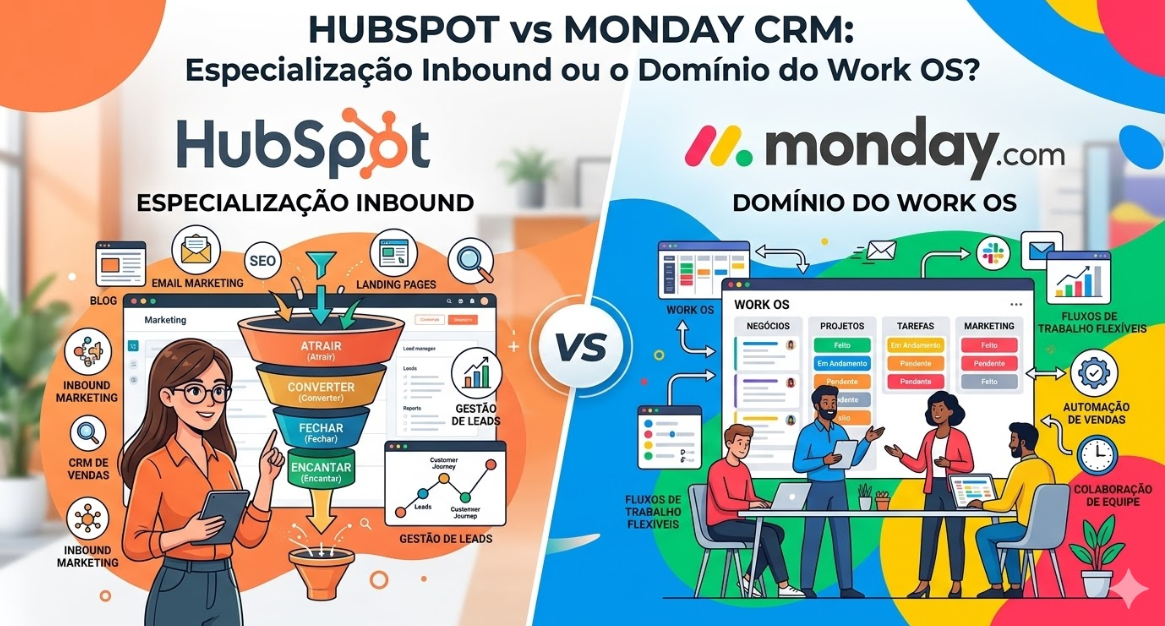
In the scalability journey of modern B2B companies, the choice of Customer Relationship Management (CRM) system has ceased to be merely a commercial department decision to become the central pillar of business architecture. When operations grow, the way a company attracts, converts, and, critically, delivers what was sold defines profit margin and retention rate. It is exactly at this intersection between Sales and Operations that corporate leaders face one of the most substantial debates in the SaaS market: monday CRM vs HubSpot.\r\n\r\nOn one hand, we have HubSpot, the absolute titan of Inbound Marketing and Sales. A massive ecosystem, designed to attract leads, nurture relationships through complex marketing automation, and close deals with surgical precision. On the other hand, monday CRM (anchored in robust monday.com), which proposes a rupture with the traditional model: instead of treating sales as an isolated silo, it transforms it into an integrated piece of a Work Operating System (Work OS) that connects sales to operations, success, and company-wide processes.\r\n\r\nAt Audatia, we’ve guided enterprises through this critical decision. What we’ve learned is fundamental: HubSpot and monday CRM are solving different organizational problems. Understanding which problem your company faces is the key to the decision.\r\n\r\n \r\n\r\n \r\n
HubSpot: The Inbound Machine
\r\n
Philosophy and DNA
\r\nHubSpot was born with a single, revolutionary mission: invert how companies acquire customers. Instead of aggressive outbound sales, attract prospects through valuable content, nurture them through targeted communication, and close them through personalized engagement. Every feature, every integration, and every capability is built to optimize this inbound process.\r\n
HubSpot’s Core Strengths
\r\n- Best-in-class lead nurturing: HubSpot’s marketing automation is the industry standard. Email workflows, lead scoring, behavioral tracking—it’s all exceptional.\r\n- Content hub integration: HubSpot includes a powerful content management system, making it the central hub for inbound content and lead generation.\r\n- Predictive analytics: HubSpot’s AI predicts deal probability, lead quality, and customer churn with impressive accuracy.\r\n- Sales sequences: Automated, intelligent email sequences that guide prospects through the funnel.\r\n- Customer success integration: HubSpot includes customer success and support features to track the entire customer lifecycle.\r\n- Ecosystem maturity: Hundreds of native integrations and a robust app marketplace.\r\n- Industry dominance: HubSpot is the clear market leader in inbound sales and marketing. Most corporate buyers are familiar with it.\r\n
HubSpot’s Limitations
\r\n- Siloed from operations: Once a deal closes, moving customer data to project execution requires integration work.\r\n- Complexity at scale: As you use more HubSpot features, the platform becomes increasingly complex.\r\n- Expensive at enterprise scale: Per-user and feature costs add up quickly.\r\n- Not designed for cross-departmental coordination: Operations, delivery, and finance don’t have native visibility into sales data.\r\n- Learning curve for non-salespeople: Finance, operations, and delivery teams find HubSpot complex and irrelevant to their work.\r\n
monday CRM: The Operational Integrator
\r\n
Philosophy and DNA
\r\nmonday CRM doesn’t try to be the best inbound machine. Instead, it’s designed to be the commercial component of a comprehensive Work Operating System. The premise is that in modern organizations, commercial success depends on seamless coordination between sales, operations, and success.\r\n
monday CRM’s Core Strengths
\r\n- Native integration with operations: When a deal closes, execution, finance, and success immediately see the information.\r\n- Visual team collaboration: All departments see the customer journey visually, reducing misalignment.\r\n- Flexible deal structures: Design deal stages to match your exact sales process.\r\n- Unified dashboards: Sales, operations, finance, and success metrics are visible in one place.\r\n- Scalable automation: Orchestrate complex processes across departments as your company grows.\r\n- Modular approach: Integrates with best-of-breed marketing tools (you don’t need to use monday.com for marketing).\r\n- Easier training: The same interface logic works for sales, operations, projects, and success.\r\n
monday CRM’s Limitations
\r\n- Not specialized for inbound marketing: monday.com has no built-in content management or sophisticated email nurturing.\r\n- Requires integration with marketing tools: You’ll use HubSpot or another tool for marketing automation and content.\r\n- Less enterprise adoption: HubSpot’s market dominance means monday.com has less “enterprise familiarity.”\r\n- Learning curve for pure sales teams: Sales teams accustomed to pure CRM tools find the general Work OS interface less specialized.\r\n
The Architectural Question: Where Does Your Value Come From?
\r\n
HubSpot’s Answer
\r\nHubSpot believes value comes from building an efficient acquisition machine. Attract more leads, nurture them better, close more deals. The company’s entire platform is optimized for this revenue generation funnel.\r\n
monday.com’s Answer
\r\nmonday.com believes value comes from efficient customer delivery. It assumes you’ll use best-of-breed tools for attraction and nurturing (like HubSpot) but that value actually comes from delivering what you’ve sold efficiently.\r\n\r\nThe truth is: both are right. But which is MORE important for your organization?\r\n
Practical Scenarios
\r\n
Scenario 1: SaaS Company with Rapid Deployments
\r\nImagine a SaaS platform with standardized, rapid deployment. Sales is the bottleneck. Marketing-qualified leads convert well, but every deal is essentially identical.\r\n\r\nHubSpot is the better choice. HubSpot’s inbound efficiency will drive more leads, and once a deal closes, deployment is standardized (minimal coordination needed).\r\n
Scenario 2: Professional Services with Complex Delivery
\r\nImagine a consulting firm where sales is relatively straightforward, but delivery is complex, requiring coordination across multiple delivery teams, finance, and client success.\r\n\r\nmonday CRM is the better choice. The challenges aren’t in acquisition; they’re in coordinating delivery. monday.com’s operational integration becomes essential.\r\n
Scenario 3: Mid-Market B2B with Growth Objectives
\r\nImagine a company planning significant growth, wanting to improve both acquisition and delivery efficiency.\r\n\r\nHybrid approach: HubSpot for marketing and sales nurturing + monday CRM for post-sale operational integration. (Note: This requires integration via Zapier or native connectors, but both platforms support it.)\r\n
Integration Possibilities
\r\nInterestingly, HubSpot and monday.com aren’t mutually exclusive. Many advanced organizations use:- HubSpot for marketing automation, lead nurturing, and inbound sales\r\n- monday.com for post-sale coordination (operations, delivery, success)\r\n\r\nThis hybrid approach is common because each platform excels in its domain.\r\n
Pricing Comparison
\r\n
HubSpot Costs
\r\n- CRM: $45-3,200/month depending on features\r\n- Marketing Hub: $50-3,000/month\r\n- Sales Hub: $45-3,200/month\r\n- Common enterprise package: ~$5,000-15,000/month for a mid-sized organization\r\n
monday CRM Costs
\r\n- All features (CRM, projects, success, operations): $40-100 per user/month\r\n- Common enterprise package: ~$2,000-4,000/month for a 30-50 person team\r\n
The Cost Equation
\r\nHubSpot is typically more expensive but does more for marketing and sales specialization. monday.com is cheaper but requires separate marketing tools.\r\n
Implementation and Time to Value
\r\n
HubSpot Implementation
\r\n- Duration: 8-16 weeks for enterprise implementation\r\n- Complexity: High (many features to configure)\r\n- Training focus: Sales methodology, marketing automation, customer success\r\n- Typical challenge: Managing feature complexity\r\n
monday CRM Implementation
\r\n- Duration: 4-8 weeks\r\n- Complexity: Medium (process design rather than technical configuration)\r\n- Training focus: How commercial data flows to operations\r\n- Typical challenge: Cross-departmental workflow design\r\n
Who Should Choose Each Platform?
\r\n
Choose HubSpot If:
\r\n- Acquisition efficiency is your primary growth lever.\r\n- Your deployment is relatively standardized once deals close.\r\n- You need best-in-class marketing automation and inbound capabilities.\r\n- Your team is comfortable with a complex, feature-rich platform.\r\n- You want the market-leading solution that most enterprises are familiar with.\r\n- Your sales process is the core competitive advantage.\r\n
Choose monday CRM If:
\r\n- Operational efficiency across sales and delivery is your priority.\r\n- Your deployment is complex and requires coordination across teams.\r\n- You already have a marketing tool you’re happy with (HubSpot, Marketo, etc.).\r\n- You want a single platform for sales, operations, and success teams to collaborate.\r\n- You value visual, collaborative work management.\r\n- You plan significant organizational growth and need efficiency gains.\r\n
Final Verdict: Acquisition Specialist vs Operational Integrator
\r\nHubSpot is the clear winner for organizations where the primary constraint is lead generation and sales efficiency.\r\n\r\nmonday CRM is the clear winner for organizations where the primary constraint is operational efficiency after the sale.\r\n\r\nFor most modern B2B companies, the answer is “both.” Use HubSpot for inbound and sales nurturing. Use monday CRM for post-sale integration and operational execution. The two platforms complement each other, and integration between them is well-established.\r\n\r\nAt Audatia, we recommend this hybrid approach for mid-market and enterprise organizations. It provides best-of-breed capabilities in both acquisition and execution—exactly what modern companies need.