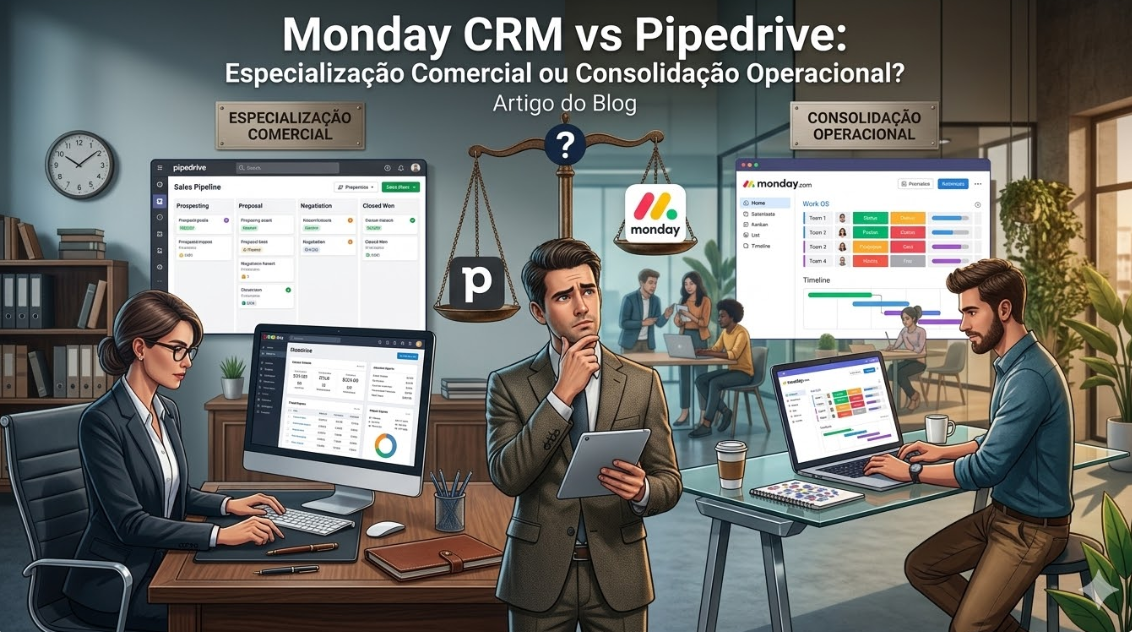
In the scalability journey of any B2B company, structuring the sales machine is frequently the first major challenge. However, closing a deal is just the beginning of the customer’s journey. It is in this scenario, where commercial promise must transform into operational excellence delivery, that commercial directors and operations leaders face one of the most pertinent debates in the software market: monday CRM vs Pipedrive.\r\n\r\nOn one hand, Pipedrive is one of the most established and acclaimed CRMs globally, designed strictly to manage sales funnels and drive conversion through rigorous methodology. On the other hand, monday CRM (built on the robust architecture of monday.com) proposes a paradigm shift: transforming the CRM, which is traditionally an isolated silo of the commercial department, into an integrated piece of a Work Operating System (Work OS) that connects sales to execution, financial management, and customer support.\r\n\r\nAt Audatia, we’ve guided dozens of organizations through this decision. What we’ve learned is that the best CRM is not necessarily the most feature-rich, but the one that best fits your organization’s maturity level and operational trajectory.\r\n\r\n \r\n\r\n \r\n
Pipedrive: The Specialist in Sales Funnel Management
\r\n
Philosophy and DNA
\r\nPipedrive was designed with a singular focus: turn salespeople into deal-closing machines. Every feature, every interaction, every workflow is optimized to move deals through the pipeline. It’s built on the belief that sales is a managed process that, when executed correctly, generates revenue.\r\n\r\nThis specialization is Pipedrive’s greatest strength. Sales teams love it because every element speaks their language. The interface is clean, the pipeline visualization is intuitive, and the system actively guides behavior.\r\n
Strengths
\r\n- Exceptional pipeline visualization: Sales teams can see exactly where every deal stands at a glance.\r\n- Activity tracking: Pipedrive forces a discipline of logging calls, emails, and meetings. This creates an auditable sales process.\r\n- Integration with sales tools: Pipedrive connects seamlessly to Mailchimp, Calendar apps, and other sales-specific tools.\r\n- Customizable deal stages: You can design your exact sales process.\r\n- Affordable pricing: For pure CRM functionality, Pipedrive is often cheaper than alternatives.\r\n
Limitations
\r\n- No project execution component: Once you close a deal, you need another tool to manage the delivery.\r\n- Limited automation across departments: Pipedrive doesn’t talk well to finance, HR, or operations.\r\n- Reporting is focused on sales metrics: It’s difficult to connect sales data to operational outcomes.\r\n- Scaling becomes complex: As you need more departments involved, integration becomes painful.\r\n
monday CRM: The Integration Layer Within a Larger Ecosystem
\r\n
Philosophy and DNA
\r\nmonday CRM doesn’t try to be the best CRM for pure sales management. Instead, it’s designed to be the commercial component of a larger Work OS. The premise is that in modern organizations, sales doesn’t exist in isolation. It’s connected to product delivery, financial management, and customer success.\r\n
Strengths
\r\n- Native integration with execution: When you close a deal in monday CRM, you can automatically create a project in execution. The sales team and delivery team see the same information.\r\n- Deep collaboration: The monday.com visual interface means sales, delivery, finance, and support all see the customer’s lifecycle.\r\n- Flexible deal stages: Like Pipedrive, you can customize deal stages. Unlike Pipedrive, you can connect each stage to actions in other areas of your business.\r\n- Unified reporting: All sales metrics connect to operational outcomes: delivery timelines, profitability, customer satisfaction.\r\n- Scalable automation: As you grow, automation rules can orchestrate increasingly complex processes across departments.\r\n- Built for team dynamics: The visual collaboration features mean sales, delivery, and support teams naturally align.\r\n
Limitations
\r\n- Learning curve: Teams accustomed to sales-specific tools find monday.com’s general interface less intuitive at first.\r\n- Requires process design: You can’t just “turn it on.” You need to design how sales connects to your other operations.\r\n- Requires better data hygiene: Because data flows across departments, one sloppy sales entry can create operational chaos.\r\n- Higher total cost of ownership: monday CRM costs more than Pipedrive, but that’s because you’re replacing multiple tools.\r\n
The Critical Question: What Happens After You Close the Deal?
\r\nThis is where the philosophical divide becomes practical.\r\n
In a Pipedrive-Centric Organization
\r\n1. Deal closes in Pipedrive.\r\n2. Sales team manually notifies delivery team (often via email or chat).\r\n3. Delivery team creates a separate project in their tool (Asana, ClickUp, etc.).\r\n4. Finance manually extracts deal information to create an invoice.\r\n5. Customer Success manually registers the client in their support system.\r\n6. Problems emerge: Deal terms are misunderstood, project scope is misaligned, delivery overruns.\r\n
In a monday CRM-Centric Organization
\r\n1. Deal closes in monday CRM.\r\n2. Automation immediately creates a project in the execution board.\r\n3. Delivery team sees the project with all commercial details (contract terms, pricing, SLA).\r\n4. Finance automatically receives deal information and can set up billing.\r\n5. Customer Success is automatically notified and receives account details.\r\n6. All teams see the same customer record, reducing misalignment.\r\n
Pricing Models: What Are You Actually Paying For?
\r\n
Pipedrive Pricing
\r\n- Starts around $12-65 per user per month\r\n- Pure CRM tool: If you need project management, accounting, support, you’re buying separate tools\r\n- Total cost for a small company (20 people): Pipedrive ($15k/year) + Project Tool ($30k/year) + Accounting ($12k/year) = ~$57k\r\n
monday CRM Pricing
\r\n- Starts around $40 per user per month (for CRM features within monday.com)\r\n- Includes project management, automation, support management\r\n- Total cost for a small company (20 people): monday.com Pro ($40k/year) replaces all three\r\n- Additional cost comparison depends on what specialized tools you need on top\r\n
Implementation and Training
\r\n
Pipedrive Implementation
\r\n- Timeline: 2-4 weeks\r\n- Training focus: Sales methodology, pipeline management\r\n- Typical challenge: Getting salespeople to actually use it (discipline is required)\r\n
monday CRM Implementation
\r\n- Timeline: 4-8 weeks\r\n- Training focus: How sales integrates with delivery, finance, and support\r\n- Typical challenge: Designing processes that work across departments\r\n
Who Should Choose Each Platform?
\r\n
Choose Pipedrive If:
\r\n- Your sales team is the primary focus, and other departments are handled separately.\r\n- You want a pure sales tool with minimal process integration.\r\n- Your delivery is standardized and doesn’t require close coordination with sales.\r\n- You have budget constraints and can afford point solutions.\r\n- Your sales process is highly consultative but doesn’t depend on integrated execution.\r\n
Choose monday CRM If:
\r\n- You want sales, delivery, and success connected in one system.\r\n- Your customers are complex and require coordination between departments.\r\n- You’re planning significant growth and need efficient processes.\r\n- You want to implement revenue operations (aligning sales, delivery, and finance).\r\n- You plan to implement AI agents and automation across your sales process.\r\n
Final Verdict: Specialization vs Integration
\r\nPipedrive is the specialist. It’s unmatched at managing the sales funnel. If your organization is sales-centric and doesn’t require deep integration with delivery and operations, Pipedrive is an excellent choice.\r\n\r\nmonday CRM is the integrator. It’s designed to make sales part of a larger operational ecosystem. If your organization depends on coordinating sales with delivery, finance, and support, monday CRM represents a fundamentally superior choice.\r\n\r\nAt Audatia, we recommend Pipedrive for pure sales-focused organizations (typically SaaS with rapid, standardized deployments). We recommend monday CRM for organizations where post-sale execution complexity is high or where you need revenue operations maturity.\r\n\r\nThe choice is not about which is “better”—both are excellent at what they do. It’s about what you need beyond sales. In most B2B organizations, what you need after the sale is closed is as important as the sale itself.