When a company surpasses the initial phase of structuring and enters a trajectory of expansion, fragmented communication and loss of traceability become its greatest adversaries. In an attempt to centralize operations, IT leaders, directors, and operational managers frequently face a fundamental architectural dilemma: monday vs Bitrix24. The choice between these two platforms will dictate not only how the team works, but the level of agility and integration that the organization will have in the coming years.\r\n\r\nOn one hand, we have Bitrix24, a monolithic system that proposes to be the “definitive intranet,” encompassing in a single package a CRM, telephony, human resources, corporate social network, and task management. On the other, monday.com, at the forefront of Work Operating Systems (Work OS), focused on modularity, deep visual collaboration, and the ability to orchestrate process execution across the entire company.\r\n\r\nAt Audatia, our field experience has taught us a non-negotiable premise: tools don’t solve processes on their own. The adoption of a system with dozens of modules without a clear implementation strategy merely digitalizes inefficiency and drives away users. In this article, we will deepen the technical and structural comparison between monday.com and Bitrix24, dissecting the data hierarchy, usability, automation, and hidden costs, so that your company can make a decision based on true operational maturity.\r\n\r\n \r\n\r\n \r\n
monday vs Bitrix24: Understanding the DNA and Philosophy of Software
\r\nTo structure a resilient operation, it is imperative to understand the premise with which each platform was designed. The original architecture of the software shapes your team’s daily behavior and determines the learning curve.\r\n
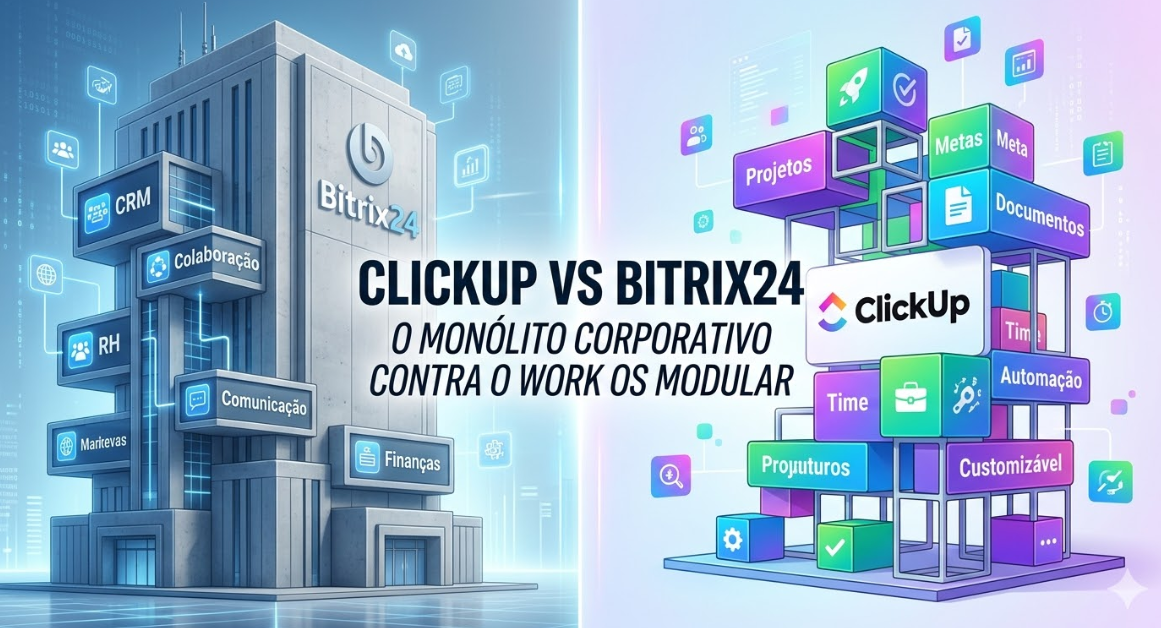
The Philosophy of Bitrix24: The Monolithic “All-in-One”
\r\nBitrix24 was built on the belief that a company should not have to piece together solutions from multiple vendors. Instead, it offers a single, centralized system. This architecture makes sense for organizations with limited IT resources that need quick deployment. However, this philosophy comes with a significant cost: rigidity. Every customization requires native development; every integration with external tools demands custom code; and every workflow that doesn’t fit the predefined structure requires months of implementation.\r\n
The Philosophy of monday.com: The Modular and Adaptive Work OS
\r\nmonday.com was built on an entirely opposite premise. Rather than attempting to be everything to everyone, it acts as the central nervous system of your operation, allowing specialized tools to connect to it. This architecture is increasingly common among next-generation platforms and reflects a truth that the market is finally internalizing: the best CRM for one company may not be the best for another; the best project management tool may not fit everyone’s workflow.\r\n
The Immediate Implication
\r\nBitrix24’s monolithic philosophy makes it more initially accessible (the learning curve is smoother because everything is integrated), but increasingly rigid as requirements become more complex. monday.com’s modular philosophy requires more planning upfront but provides infinitely greater flexibility and long-term scalability.\r\n
Operational Integration: How Data Flows (or Gets Stuck)
\r\n
Bitrix24: The Data Silos Within a “United” System
\r\nDespite being marketed as a unified system, Bitrix24 has a fundamental problem: its data structure is compartmentalized. The CRM data doesn’t naturally flow to projects; project information doesn’t automatically inform HR; HR data doesn’t connect to financial processes. To make these connections happen, you need either expensive configurations or, more commonly, custom code.\r\n
monday.com: Native Interoperability
\r\nmonday.com was built with the premise that data should flow seamlessly. A client registered in the CRM immediately becomes available in project management; project milestones automatically notify relevant teams; financial information integrates natively with project budgets. This isn’t a configuration; it’s architectural.\r\n
Audatia’s Perspective
\r\nIn dozens of implementations of both platforms, we’ve observed that data flow is where the greatest friction occurs. In Bitrix24 migrations, approximately 70% of project failures stem from data silos that require expensive custom integration work. In monday.com implementations, this friction is significantly reduced because the data model was designed for connectivity from the ground up.\r\n
Process Automation: The Invisible Multiplier
\r\n
Bitrix24: Automation for Repetitive Processes
\r\nBitrix24 offers workflow automation capabilities, but they operate in isolation. You can automate a sales process in the CRM, a separate project workflow, and HR approval steps, but connecting these three automations requires technical intervention. The platform was not designed with cross-functional automation in mind.\r\n
monday.com: Automation as Architecture
\r\nmonday.com’s automation layer is fundamentally different. Because the platform was built as a Work OS from the start, automation rules can orchestrate actions across projects, CRM, HR, finance, and any other system connected to the ecosystem. A single automation can span multiple business areas without manual intervention.\r\n
Real Example
\r\nWhen a new customer is registered in monday CRM: the system automatically creates a project in the execution board, assigns the relevant team members, schedules the onboarding tasks, notifies finance to set up billing, and triggers HR to schedule the relationship manager. All of this happens in a single orchestrated flow. In Bitrix24, you would need to create separate automations in each module and likely involve a developer to bridge them.\r\n
Customization and Scalability: The Long-Term Cost
\r\n
Bitrix24: Initial Flexibility, Long-Term Rigidity
\r\nBitrix24 offers extensive customization through its plugin ecosystem, but true differentiation requires custom code. As your organization grows and complexity increases, you’ll face an increasing number of scenarios where the predefined modules don’t fit your needs. Each of these scenarios will require development resources.\r\n
monday.com: Designed for Scalability
\r\nmonday.com was architected to scale horizontally. Rather than adding more code and modules, you add new apps and integrations. The platform supports hundreds of native integrations, and through tools like Zapier and n8n, you can connect virtually any tool in the market. This creates a fundamentally more scalable architecture.\r\n
The Cost of Growth
\r\nIn Bitrix24 environments, as the organization grows, development costs increase linearly (or more) with complexity. In monday.com environments, incremental costs decrease as the integration ecosystem matures.\r\n
Implementation Timeline and Hidden Costs
\r\nBitrix24 implementations typically appear faster upfront (3-4 months) but accumulate hidden costs as customization needs emerge. monday.com implementations require more careful planning upfront (4-6 months) but stabilize faster and have lower total cost of ownership.\r\n
The True Equation
\r\nTotal Cost of Bitrix24 = License Costs + Implementation + Development + Ongoing Customization\r\nTotal Cost of monday.com = License Costs + Strategic Implementation + Ecosystem Integration\r\n
Final Verdict: Which One to Choose?
\r\n
Choose Bitrix24 If:
\r\n- Your organization is under 50 people and needs a quick deployment with pre-integrated modules.\r\n- You have limited IT resources and prefer a self-contained solution.\r\n- Your processes are relatively standard and don’t require significant customization.\r\n- You want to avoid third-party integrations and prefer a closed ecosystem.\r\n
Choose monday.com If:
\r\n- Your organization plans to scale and complexity will increase.\r\n- You already use specialized tools (like HubSpot, Pipedrive, or specific accounting software) and need to integrate them.\r\n- Your team needs deep visual collaboration and process transparency.\r\n- You want a platform that adapts to your processes, not the other way around.\r\n- You plan to implement AI agents and automation across your operation.\r\n
The Audatia Recommendation
\r\nFor organizations planning growth beyond 100 people or with complex operational needs, monday.com represents a fundamentally superior architectural choice. The initial investment is higher, but the long-term flexibility, scalability, and reduced hidden costs make it the winning choice in virtually every scenario where operational maturity is a priority.\r\n\r\nFor smaller organizations with stable processes and limited growth projections, Bitrix24 can deliver immediate value. However, understand that as you grow, architectural reworking will likely become necessary—and that rework is expensive.\r\n\r\nThe choice, ultimately, is not between two tools; it’s between two philosophies of how software should evolve with your organization. Choose wisely.